How to Get a CDL: A Step-by-Step Guide for New Truck Drivers

Get Big Rig Daily free every morning
The trucking stories drivers are talking about, in one short email. Free. Unsubscribe any time.
A commercial driver's license, or CDL, is the license needed to drive a semi truck for a living. According to the Federal Motor Carrier Safety Administration (FMCSA), drivers have been required to hold a CDL for certain commercial vehicles since April 1, 1992. States issue the licenses, but they follow federal standards. Here is how the process works, one step at a time.
This guide is general information, not legal advice. Rules can change and states add their own requirements, so check with your state licensing agency and the FMCSA website before making decisions.
Get Big Rig Daily free every morning
The trucking stories drivers are talking about, in one short email. Free. Unsubscribe any time.
Step 1: Choose the right license class
Federal rules sort commercial licenses into three classes:
- Class A covers combination vehicles with a gross combination weight rating of 26,001 pounds or more, when the towed unit is rated over 10,000 pounds. A tractor pulling a semi trailer falls into this group.
- Class B covers single vehicles rated at 26,001 pounds or more, towing no more than 10,000 pounds.
- Class C covers smaller vehicles that carry 16 or more people, including the driver, or haul placarded hazardous materials.
Under federal rules, a driver who passes the Class A tests may also drive Class B and Class C vehicles, as long as the driver holds any needed endorsements. Driving a tractor-trailer generally calls for a Class A license.
Step 2: Check the age and medical rules
Age
Federal rules say a person must be at least 18 to hold a commercial learner's permit. FMCSA's driver qualification rules in 49 CFR 391.11 set a minimum age of 21 for the drivers those rules cover. Each state sets its own licensing details, so check with the state licensing agency before signing up for training.
The medical card
Drivers must pass a physical exam to get a Medical Examiner's Certificate, Form MCSA-5876, according to FMCSA. Federal rules generally require a new exam at least every 24 months, and some drivers with certain conditions must be checked every 12 months. FMCSA's website has a tool to find a medical examiner.
The BLS notes that federal rules require at least 20/40 vision with a 70-degree field of vision in each eye, the ability to tell the colors on a traffic light, and the ability to hear a forced whisper at 5 feet in one ear, with or without a hearing aid.
Step 3: Get a commercial learner's permit
The commercial learner's permit, or CLP, comes first. Federal rules make it a required step before a first CDL. To get one, an applicant passes a general knowledge test for the type of vehicle he or she plans to drive.
Key federal rules for permit holders:
- A CDL holder with the right class and endorsements must ride in the front seat next to the permit holder.
- The permit is valid for no more than one year before the knowledge tests have to be retaken.
- A permit holder cannot take the CDL skills test during the first 14 days after the permit is issued.
- Only three endorsements are allowed on a permit: passenger (P), school bus (S) and tank vehicle (N). Permit holders may not haul hazardous materials.
Step 4: Complete entry-level driver training
Since February 7, 2022, people getting a Class A or Class B CDL for the first time, or upgrading from Class B to Class A, must complete entry-level driver training. The same goes for anyone getting a passenger, school bus or hazardous materials endorsement for the first time.
The training must come from a provider listed on FMCSA's Training Provider Registry, and FMCSA says it must be finished before the skills test. Federal rules also say the classroom portion and the behind-the-wheel portion must be completed within one year of finishing the first portion, except for hazardous materials endorsement training.
According to the BLS, many future drivers attend a private truck driving school or a community college program that lasts between 3 and 6 months.
Step 5: Pass the skills test
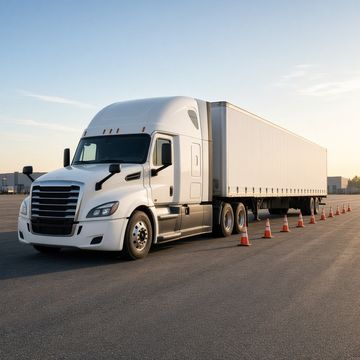
The skills test is given by the state in a vehicle that matches the class being sought. FMCSA advises testing in the same type of vehicle the driver plans to operate, because testing in a different setup can add a restriction to the license. Examples from FMCSA:
- E restriction: the test was taken in a truck with an automatic transmission, so the driver may not drive a manual.
- L restriction: the driver did not pass the air brake portion or tested without full air brakes.
- O restriction: a Class A test taken with a pintle hook instead of a fifth wheel.
Step 6: Add endorsements if needed
Endorsements allow special kinds of driving. FMCSA lists them as:
- T: double or triple trailers (knowledge test)
- N: tank vehicle (knowledge test)
- H: hazardous materials (knowledge test)
- X: tank vehicle and hazardous materials combined (knowledge test)
- P: passenger (knowledge and skills tests)
- S: school bus (knowledge and skills tests)
The BLS notes that the hazardous materials endorsement also requires a background check.
After the license
The BLS says new drivers usually get several weeks of on-the-job training with an experienced mentor after they are hired. CDL holders must keep a clean driving record and are subject to random drug and alcohol testing, according to the BLS. For a current debate over when those tests can be ordered, see Big Rig Daily's story on a trucker's petition over random drug tests on days off.
New drivers also face equipment choices. Big Rig Daily's report on used sleeper truck prices found that J.D. Power links firm prices partly to new drivers needing clean used trucks.
Once licensed, every driver works under federal hours limits. The hours of service and ELD guide covers those rules, and the truck driver pay by state guide shows what drivers earn.
Frequently Asked Questions
How long does it take to get a CDL?
It depends on the training program and state testing schedules. Federal rules require holding a learner's permit for at least 14 days before the skills test, and the BLS says many school programs last 3 to 6 months.
How old does a driver have to be to get a CDL?
Federal rules require permit holders to be at least 18. FMCSA's driver qualification rules set a minimum age of 21 for the drivers they cover. Check with the state licensing agency for its rules.
What is entry-level driver training?
It is a federal training standard that took effect February 7, 2022. First-time Class A and Class B applicants must complete it with a provider on FMCSA's Training Provider Registry before taking the skills test.
Can the CDL skills test be taken in an automatic truck?
Yes, but FMCSA says the state will add an E restriction, which bars driving a truck with a manual transmission.
Is a medical card required for a CDL?
Yes. FMCSA requires a Medical Examiner's Certificate, and federal rules generally call for a new exam at least every 24 months.
Share your thoughts on our Facebook page.
Save this story for later

Sources
- FMCSA: Commercial Driver's License, Drivers (classes, endorsements, restrictions, ELDT)
- eCFR 49 CFR 383.25 Commercial learner's permit
- eCFR 49 CFR 383.91 Commercial motor vehicle groups
- eCFR 49 CFR 383.93 Endorsements
- eCFR 49 CFR 380.603 ELDT applicability
- eCFR 49 CFR 380.609 ELDT requirements
- eCFR 49 CFR 391.11 General qualifications of drivers
- eCFR 49 CFR 391.45 Medical examination timing
- FMCSA: Driver Physical Qualification (Form MCSA-5876)
- BLS Occupational Outlook Handbook: Heavy and Tractor-Trailer Truck Drivers, How to Become One
Get Big Rig Daily free every morning
The trucking stories drivers are talking about, in one short email. Free. Unsubscribe any time.
More from Big Rig Daily
- Hyundai Translead Adds 1,250 Jobs to Planned Illinois Trailer Plants

- Trucker Asks FMCSA to Stop Random Drug Test Notices on Drivers' Days Off


